Get started
Still unsure of the impact of Sonik?
See it for yourself and ask for your free trial


Stop chasing a prospect when they have shown you, twice, that the problem is not a priority: a second reschedule, a budget with no owner, a timeline with no consequence, a relationship where you give and they take, a silence that an email cannot break. Each sign has a question that confirms it, and the answer is never "send another follow-up". It is a call, then a decision: push with a date or park as a signal. Here is how we run it, with the numbers from our benchmark of 1,000,000 B2B cold calls where they apply.
A lost deal costs you the time you spent. A chased deal costs you that plus every hour of the next quarter, plus the forecast it pollutes, plus the pipeline you did not build because the calendar was full of "checking in". AEs spend only around 40% of their day selling in our experience; a dead deal eats a share of that 40% every week it stays open.
The alternative is not giving up. It is deciding, from evidence, and putting the contact where it will be useful later.
One reschedule is life. Two is a message. The prospect has decided, at least for now, that something else matters more, and they are too polite to say so.
Question to ask, by phone: "Is this something you want to solve this quarter, or is it more of a next-year topic?" Most people answer honestly when asked directly. If it is next year, park the deal with a date and a reason. If it is this quarter, book the meeting on the call with a fixed slot and confirm it by text.
"We do not have budget" is not the sign. Budget appears when a problem is painful enough. The sign is budget with nobody who could create it: your contact cannot name the person who would sign, or names someone they have never spoken to about this.
Question: "If this went ahead, who would put their name on the order?" A name you can call is a deal. "I would have to see" is a parked contact. Multithreading by phone is the fix when there is a name; we laid it out in multithreading by phone: call the whole buying committee.
"Probably Q2", "we are figuring it out", "once things settle down". The language matters: a prospect with a real deadline says "before the audit in May" or "when the current contract ends in March". A prospect without one uses "probably" and "figure out".
Question: "What happens on your side if nothing has changed by then?" If the answer is a cost (a renewal, a hire, a penalty, a launch), the timeline is real and you can plan to it. If the answer is "nothing really", the deal has no engine. Park it.
Three demos, a custom proposal, two reference calls, a security questionnaire, and in return: nothing. No access to the user, no number on the problem, no introduction upward. One-sided deals rarely close, and when they do they become one-sided customers.
Question, before the next favour: "Happy to do that. Can we set up 20 minutes with the person who would use this, so the proposal is built on their numbers?" A yes is progress. A no tells you who you are dealing with.
The most common sign and the most badly handled. The reflex is a fourth email, "just bumping this". Email is where silence lives. The right move is one call, at the slot the persona picks up (4pm has a 15.8% connect rate in our data, 10am 14%), with a human opener, not a chase.
If the call does not connect after two attempts in two slots, park the contact as a dormant lead with the last known state. Do not send the fifth email.
Here is what competitors' "stop chasing" advice misses. A parked prospect is one of the warmest contacts you own. They know you, they told you why not, and their situation will change. Called back on a trigger, a job change, a funding round, a renewal window, with "How have you been?", a dormant contact reaches around 10% success in our benchmark against roughly 1.5% for a standard cold open.
So park properly: the reason (sign 1 to 5), the date or the trigger to watch, the names you collected, and a disposition the dialer can act on. Half of Sonik's own pipeline comes from signals that were already in the CRM, and parked deals are a large share of those. We wrote the full method in how to reactivate dormant leads.
Forecast accuracy improves within a month, and the freed hours go into new conversations, which is where the next quarter comes from.
In Sonik a parked deal does not disappear into a closed-lost bucket. The contact keeps the reason and the trigger to watch, and the signals engine watches it: a job change, a visit to the pricing page, a new hire in the team, the renewal window you logged. When the trigger fires, the contact comes back into the call list with the context on screen.
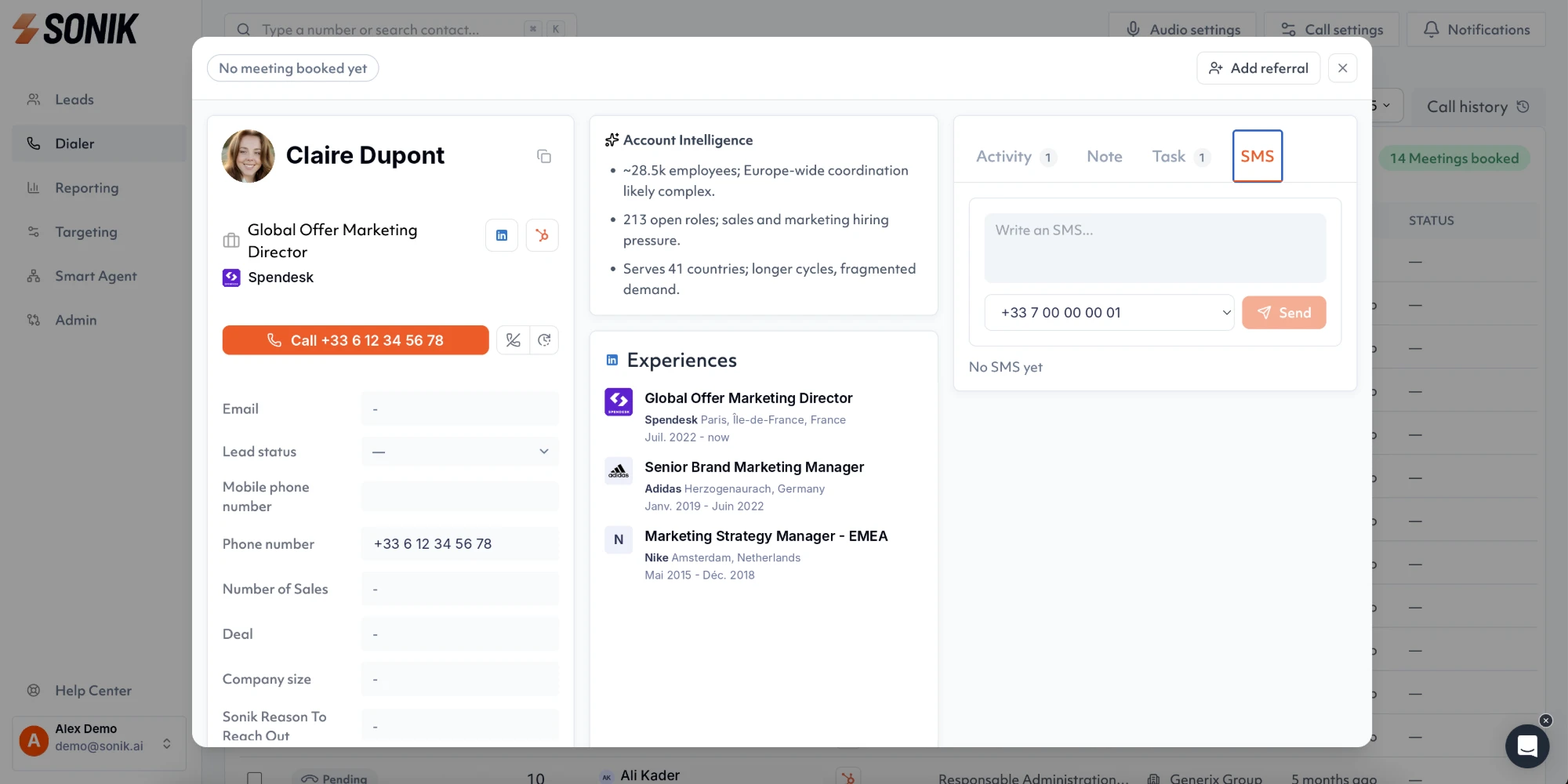
The rep sees the history, the sign that parked it and the AI qualification of why now, and opens with "How have you been?" instead of a cold pitch. The five questions above are in the call prep so the AE asks them on the first stalled call, not the fourth.
Chasing is a habit; disqualifying is a skill. This week, take your five oldest stalled deals, name the sign for each, and ask the matching question by phone. Push the ones with a date, park the rest with a trigger. Then count how many of the parked ones come back on their own in the next six months. In our experience, more than you expect.

