Get started
Still unsure of the impact of Sonik?
See it for yourself and ask for your free trial


Text a prospect when the message can be resolved without a reply, and only after they have heard your voice at least once. Call them when you need a decision. A text is a good follow-up to a conversation and a poor replacement for one: in our benchmark of 1,000,000 B2B cold calls, the meeting is booked on the call, and the SMS is what makes sure it actually happens.
This guide covers the three moments where texting beats a second dial, the moments where it hurts, the consent question in Europe, and the short templates our SDRs use.
Ask one question before choosing the channel: does this message need the prospect to answer? If no, text. "Here is the link I promised", "Confirming Thursday 10am", "Tried to reach you, I will call back at 4pm" all work as texts because they are complete on their own.
If the message needs a reply, call. Discovery, an objection, a question about price, a proposal for a next step: these are conversations, and a conversation over SMS takes four days and ends in silence. Phone-first is not a preference, it is where the outcome gets decided.
You called, it went to voicemail, you left 15 seconds. A one-line text within a minute doubles the chance the prospect connects the name to the number when you call back. Keep it factual: who you are, why you called, when you will try again. No pitch.
The meeting was booked on the call. The invite went by email, where it sits with 80 other unread messages. A text confirming the day and time, sent while the prospect still remembers your voice, is the single cheapest no-show reducer we know. We cover what else to confirm before hanging up in Qualified meeting: 7 things to confirm before you hang up.
"Send me the details and I will look" is sometimes a brush-off and sometimes real. Either way, honour it fast and by the channel they chose. A text with one link and one sentence, then a call two days later to ask what they thought. The call is still where you learn the answer.
We are not lawyers, so take the following as operating rules rather than legal advice. In France and across the EU, B2B prospecting by phone and by SMS do not follow the same logic: calling a professional on a professional number is broadly accepted practice, while unsolicited commercial SMS to a mobile is treated much more strictly, and a mobile is often considered personal even when the owner is a professional.
The practical consequence is simple. A text after a conversation, with the prospect's awareness, sits on much firmer ground than a cold text to a list. Record where each number came from, record the conversation that preceded the text, and honour any "stop" instantly, whatever channel it arrives on. If your legal team says a given segment is call-only, it is call-only.
Short, named, with one next step. Adapt the vouvoiement in French.
Three lines maximum, no emojis, no link in a first voicemail follow-up if you can avoid it. The goal of each is recognition on the next call, not a reply.
The channel should follow what the prospect did last, not a fixed step number in a cadence. Picked up and booked: text to confirm. Picked up and said "later": call back at the date they gave, no text in between. Voicemail: text once, call again in two days. Opened the link you texted: that is a signal, call within the hour. Reps only use about 20% of the signals already in their CRM; a text that was opened is one of the easiest to act on.
In Sonik, SMS lives on the contact view next to the call button, so a rep can send the confirmation text ten seconds after hanging up without leaving the session. The text is logged on the contact with the call, and the consent context (which conversation it followed) is part of the record.
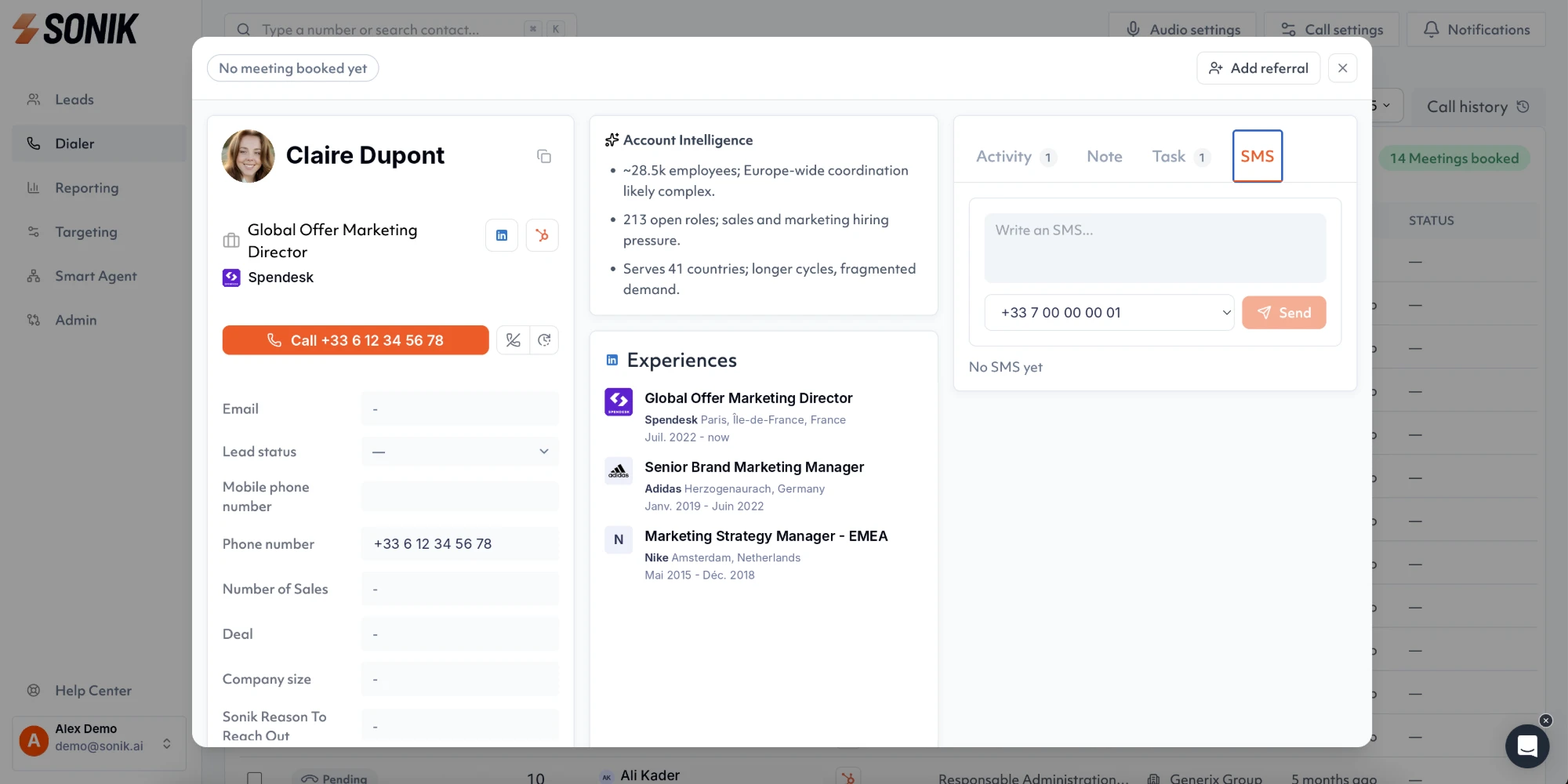
The contact view also shows the signals that justify the next call: a link opened, a visit to the pricing page, a job change. That is how we keep texting in its place. It confirms and it reminds; the call still does the selling. The dialer and the SMS share one screen because they share one goal: 20 real conversations per SDR per day.
Text to close loops, call to open them. This week, add one text to your routine: the confirmation sent within a minute of booking a meeting. Track no-shows for the next 30 days. Then, and only then, decide whether a post-voicemail text earns a place in your cadence too.

