Get started
Still unsure of the impact of Sonik?
See it for yourself and ask for your free trial


No, AI cannot put your outbound on autopilot, and the B2B companies actually making revenue are not trying to. AI is excellent at preparing calls, finding the right signals and removing the waiting between conversations. It is not a substitute for a human talking to a prospect. Here is where the line sits, and how to tell a useful AI tool from an overpromise.
You have seen the posts. "Comment Claude to put your outbound on autopilot." "Let AI book your meetings." Complex n8n diagrams with forty nodes. AI SDRs promising to replace your BDR team by next quarter.
It is the biggest overpromise on LinkedIn right now, and we see it every day because we sell to the same people it targets: sales leaders under pressure to produce pipeline with a flat headcount.
Now look at who is actually making revenue. Fast-moving American tech companies do not scale by commenting "Claude" under posts. They hire, train and retain real human sellers, in each location they sell into. The workflows are not the moat. The people are.
A B2B purchase is a bet. The buyer bets their budget, their credibility and sometimes their job on your product working. What makes them take the bet is trust, and trust is transferred from one person to another. It is not built by avoiding your prospects. It is built by talking to them, listening, challenging and connecting.
The data from the 1,000,000 B2B cold calls we analyzed with Katana shows what that looks like in practice. Discovery questions starting with "how" lift conversion by 190%. Asking "What do you mean?" before answering an objection lifts it by 197%. Both are acts of listening. Both require a human who can hear what the prospect is actually saying and adjust.
Sales never was about hiding behind a screen. Not yesterday, not today, not ever. Pretending the whole job can become a robot game is a fantasy, and in our experience the teams who believe it end up with a full outbox of unanswered sequences and an empty pipeline.
None of this means AI is useless in sales. It means AI should be pointed at the parts of the job that are not the conversation. There are three of them.
Reps use about 20% of the signals already in their CRM. Website visitors, job changes, closed-lost deals, dormant leads, prospects engaging with competitors. AI is very good at scanning all of that every morning and ranking who deserves a call today. 50% of Sonik's pipeline comes from signals that were already in the CRM.
At an 11.3% average connect rate, most of a rep's calling hour is rings and voicemails. Parallel dialing with voicemail detection gives reps 5x more live conversations: 16.2 an hour against 3.2 by hand in our benchmark. That is automation applied to the 90% of the time when nobody is talking.
Account research, the trigger for the call, the last three interactions, the likely objection. AI can assemble that in seconds before each pickup. The rep still has to use it. Trigger-based openers reach a 7-10% meeting rate versus 2-3% for pitch-first, but only if a human says the trigger out loud.
Four questions, in order.
Sonik is built on a simple split: AI does the preparation and the waiting, the human does the conversation. Signal agents scan the CRM for website visitors, job changes, closed-lost and dormant leads and build a warm list every morning. A parallel dialer removes the rings and voicemails so the rep gets 5x more live pickups. AI call prep puts the reason to reach out on screen before each connect.

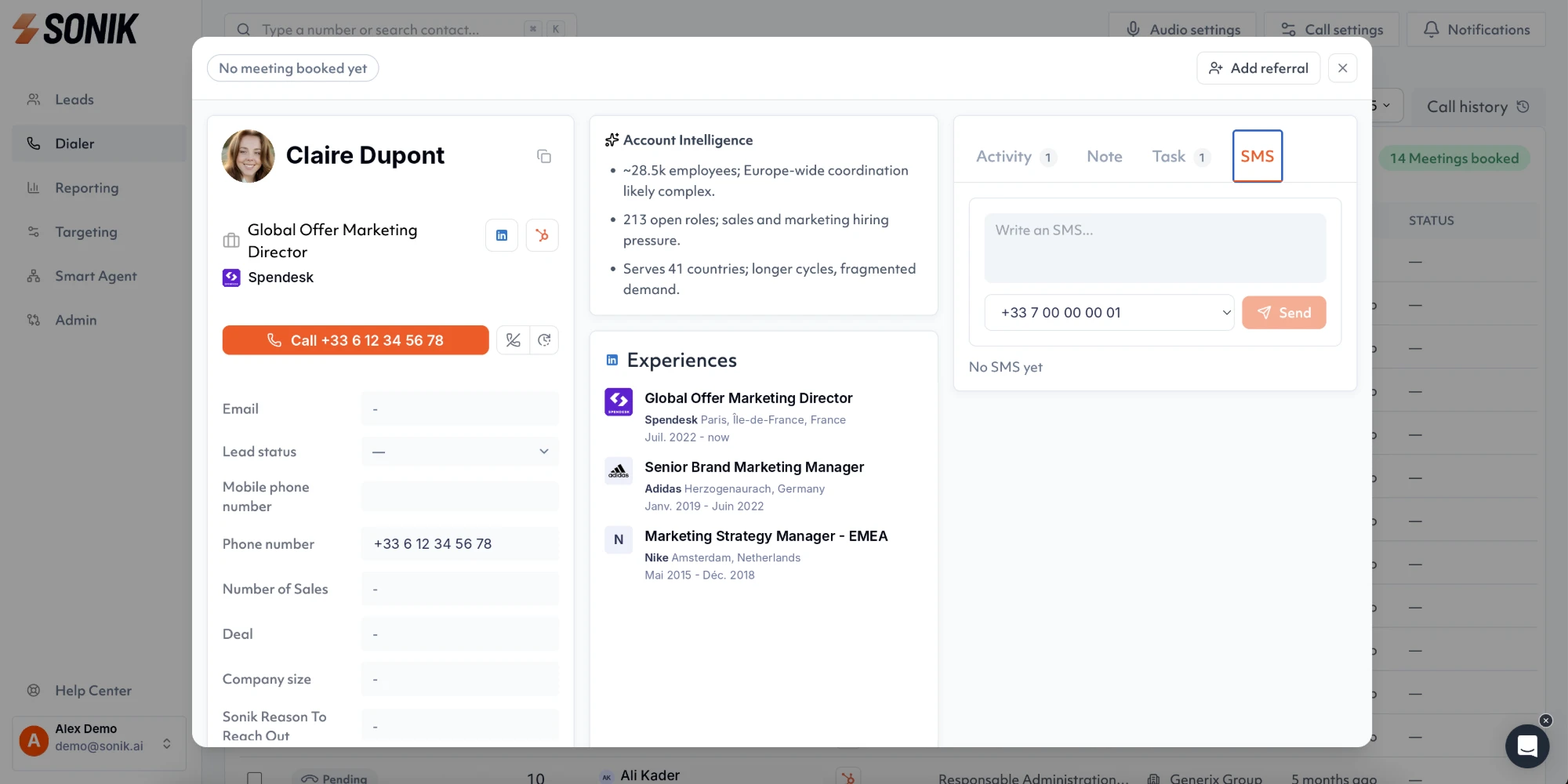
What we deliberately do not do is talk to the prospect for the rep. Our north-star is 20 conversations per day per SDR, held by a person, for 2x more meetings. The product is on the dialer and signals pages.
Use AI to prepare better. Use AI to identify the right signals. Use AI to delete the waiting between conversations. Do not use it as an excuse to stop selling. This week, count how many live conversations each rep held per day, and ask whether your AI budget is increasing that number or replacing it. You do not need to comment "Claude" to find out.

