
Why Prospects Ghost After the Demo, and How to Call Them Back

Prospects go silent after a demo because the deal lost its owner on their side, not because they disliked you. No next step was booked, the decision-maker was not in the room, a priority moved, or an objection was never said out loud. Re-engage by phone, with a new reason and one clear question, inside a short sequence that ends with a clean close.
First, check that it is really ghosting
Open the activity log before you label the deal. Two "just checking in" emails are not a follow-up. How many calls were made, on which number, at which hour?
Check the calendar too. In France, silence from mid-July to the end of August is the season, not a verdict. The same goes for the weeks of May bank holidays and the last two weeks of December.
And check what they told you. If the prospect said "we have a committee on the 20th", quiet until the 20th is the process working.
Our working definition: a prospect is ghosting when three or more attempts, on at least two channels, over about two weeks, got no reply and no reason was given. Anything less is a follow-up that has not happened yet.
Five reasons prospects go quiet after a demo
In our experience these are the causes, starting with the most frequent.
- No next step was booked during the demo. "I'll come back to you" has no date, so it has no owner.
- The person who decides was not there. Your contact now has to resell your product internally, without you, and it is not their job.
- The demo showed features, not their problem. They liked it. They cannot explain to a colleague why it matters this quarter.
- An objection stayed unspoken. Price, integration effort, an internal sponsor of another option. People avoid saying it, so they avoid you.
- The priority moved. A reorganisation, a budget freeze, a champion pulled onto something else.
You cannot tell which one it is from silence. You can only find out by talking to them, which is why the channel matters.
Why the callback beats a fourth email
An email asks the prospect to write a refusal. Most people would rather not, so they do nothing. A call lets them say "not now, because of X" in twenty seconds, and that sentence is worth more than a month of silence.
This is also not a cold call. In our benchmark of 1,000,000 B2B cold calls, a call to a known contact that opens with "How have you been?" reaches about 10% success, against roughly 1.5% for a standard cold open. Someone who sat through your demo is the warmest kind of known contact.
Pick the hour the way an SDR would. Across personas, 4pm connects best at 15.8%, ahead of 10am at 14% and 8am at 9.8%. Founders pick up more around 10am, marketing around 4pm, HR around 1pm. Use the mobile number from the meeting invite or the email signature, not the switchboard.
The callback, word for word
The opener. "Hi Claire, it's Thomas from Acme. We did the demo on the 12th. I'm not calling to push for a decision. How have things moved on your side since then?"
One question, starting with "how". In our data, discovery questions that start with "how" lift conversion by 190%. Then stop talking.
If the answer is vague. "We're still thinking about it" is an objection in disguise. Do not answer it. Ask: "What do you mean by still thinking?" Asking that before responding to an objection lifts conversion by 197% in our benchmark. The real reason usually arrives in the next sentence.
Give permission to say no. "If it's off the table, tell me. A clear no helps me more than a maybe." People who were avoiding you often relax at this point, and some of them turn out not to be a no.
Close on a date. Either a next step in the calendar before you hang up, or an agreed month to talk again. Not "I'll let you get back to me".
The voicemail. Fifteen seconds, no guilt, one new piece of information and your next attempt: "I have the answer to your question about the HubSpot sync. I'll try you again Thursday at 4."
A finite sequence: four touches in two weeks
- Day 0 or 1: the recap email. Their problem in their own words, what was agreed, the next date. Sent the same day or the next morning.
- Day 3 or 4: first call, at the persona's hour. No answer: the short voicemail, plus one line by email or text that refers to it.
- Day 7 or 8: second call, at a different slot, with something new. An answer to a question raised in the demo, a result from a comparable customer, or a signal on their account.
- Day 12 to 14: last call, then the closing message. "I'll close the file on my side on Friday. If it's only a question of timing, tell me the month and I'll call then."
Then stop. Mark the deal closed-lost with the reason "no decision" and a revisit date. Do not delete it and do not leave it open to flatter the forecast.
Two rules for the sequence. Bring in other stakeholders with your contact's knowledge, not behind their back: "Who else should I talk to so you don't have to carry this alone?" And do not discount into silence. You would be negotiating against yourself with someone who has not objected to the price.
Prevent the silence before the demo ends
Most ghosting is decided in the last five minutes of the demo.
- Book the next meeting while you are still on the call. Calendars open, invite sent before goodbye.
- Ask how the decision gets made. "How will this be decided on your side, and who is involved?"
- Ask what happens if nothing changes. If the answer is "nothing much", you have a nice demo and no deal.
- Agree on the silence rule. "If I don't hear from you by the 20th, is it fine if I call your mobile?" A callback they agreed to is not an intrusion.
How Sonik approaches post-demo silence
We treat a quiet deal as a contact waiting for a signal, not as a reminder in two weeks. The signal engine watches the account: a return visit to the website, a job change, social intent. The next signal gives the callback its new reason.
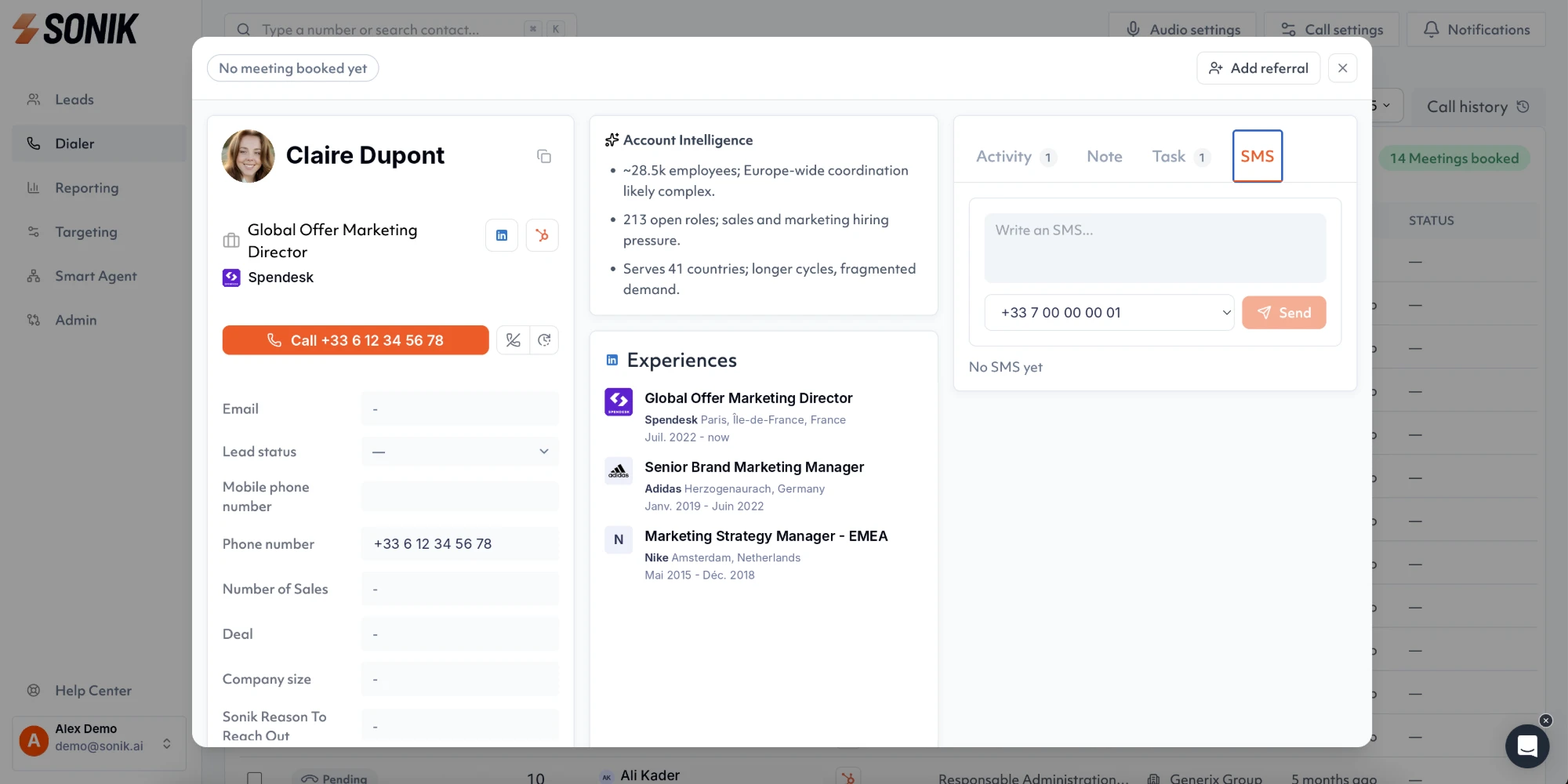
Before the call, AI call prep puts the account intelligence and the contact's background on one screen, so the callback opens with the context of the deal and what changed since, not with "just following up".
Deals closed as "no decision" stay in play. Reps use only about 20% of the signals already in their CRM, and half of our own pipeline comes from signals that were already there. We describe the method in how to reactivate dormant leads.
Conclusion
Silence after a demo is missing information, and the phone is the fastest way to get it. Call at the persona's hour, ask one "how" question, make a no easy to say, and end the sequence on a date. This week, take your three quietest post-demo deals and call each one before sending another email.