Get started
Still unsure of the impact of Sonik?
See it for yourself and ask for your free trial


Outbound in 2026 is converging on one metric: live conversations with the right person. Dials, emails sent and sequence steps are inputs; the meeting comes from the conversation. Everything else on this list, signal-built lists, AI pre-call prep, caller ID health, live coaching, follows from that. Here are the seven trends we see from the inside, running an outbound team in France and analysing 1,000,000 B2B cold calls with Katana, with the numbers that back each one.
For a decade the SDR dashboard counted dials. In 2026 the teams that grow count conversations. The reason is arithmetic: in our benchmark the average connect rate is 11.3%, so 100 dials is 11 conversations on a good list and 6 on a bad one. The dial count hides the difference; the conversation count exposes it.
Our north-star funnel is 20 conversations a day per SDR. At that volume, with trigger-based openers converting at 7 to 10%, an SDR books one to two meetings a day without heroics. Set the target on conversations and the team starts fixing the inputs that matter: list quality, timing, numbers.
The 2020 list was an export: industry, headcount, title. The 2026 list is a queue ordered by signals: a job change, a website visit, a closed-lost deal past its renewal, a dormant lead who opened something, a hiring wave. Reps only use about 20% of the signals already in their CRM, and 50% of Sonik's pipeline comes from signals that were already there.
The trend is not "buy intent data". It is "look at what you already have". The dormant lead called with "How have you been?" reaches around 10% success in our data against 1.5% for a standard cold open. That is a signal-built list in one number.
The AI SDR that calls prospects on its own did not take over outbound, and in our experience it will not in 2026 either; we explained why in why AI SDRs can't put your outbound on autopilot. What AI is taking over is the 10 minutes before the call: the account summary, the person's experiences, the trigger, the likely objection. The rep gets a brief in seconds and spends the time on the conversation.
The test for any "AI for sales" feature in 2026 is simple: does it increase the number or the quality of human conversations? If yes, keep it. If it replaces them, measure twice.
Spam labelling is tightening on every carrier, in the US first and in Europe behind it. A flagged number can lose a large share of its pickups overnight, and most teams discover it weeks later when a rep complains. In 2026 the serious teams treat number health like email deliverability: a weekly check, a rotation policy, an owner in sales ops. We laid out the fixes in why your number shows as spam and how to fix it.
This is the trend we see most clearly from Paris. Email reply rates in European B2B keep falling, LinkedIn is saturated, and the phone, which many teams abandoned around 2019, is back as the primary channel. The connect rates support it: 15.8% at 4pm and 14% at 10am across personas, above 15% for sales and leadership personas. A French SDR who calls at the right slot with a trigger has a better meeting rate than any sequence we have measured.
Phone-first in Europe comes with its own rules, Bloctel in France, opposition lists elsewhere, GDPR on the data, and the teams winning in 2026 are the ones that built those rules into the dialer rather than into a PDF nobody reads.
The weekly call review is not dead, but it is late. By the time a manager listens to Tuesday's call on Friday, the rep has made 400 more. In 2026 coaching happens in the session: the opener is scored as it happens, the objection gets a prompt, the "What do you mean?" move (which lifts conversion by 197% in our data) is suggested when the rep forgets it. We compared both models in real-time AI coaching vs call reviews.
The manager's job shifts from listening to calls to designing what the live coach looks for.
The 2023 outbound stack had a sequencer, a dialer, a data tool, a signals tool, a coaching tool and a CRM, with a rep swivelling between them. The trend is consolidation around the moment that matters: the dialer, the signals and the pre-call brief on one screen, the CRM written automatically. Not because one tool must do everything, but because every swivel costs a conversation. Sales teams use only around 20% of their stack anyway.
We built Sonik on the first trend and the others followed. The dialer counts conversations and meetings, not dials. The call list is ordered by the signals already in the CRM, and each contact arrives with an AI brief: account intelligence, experiences, the trigger and a qualification of why now.
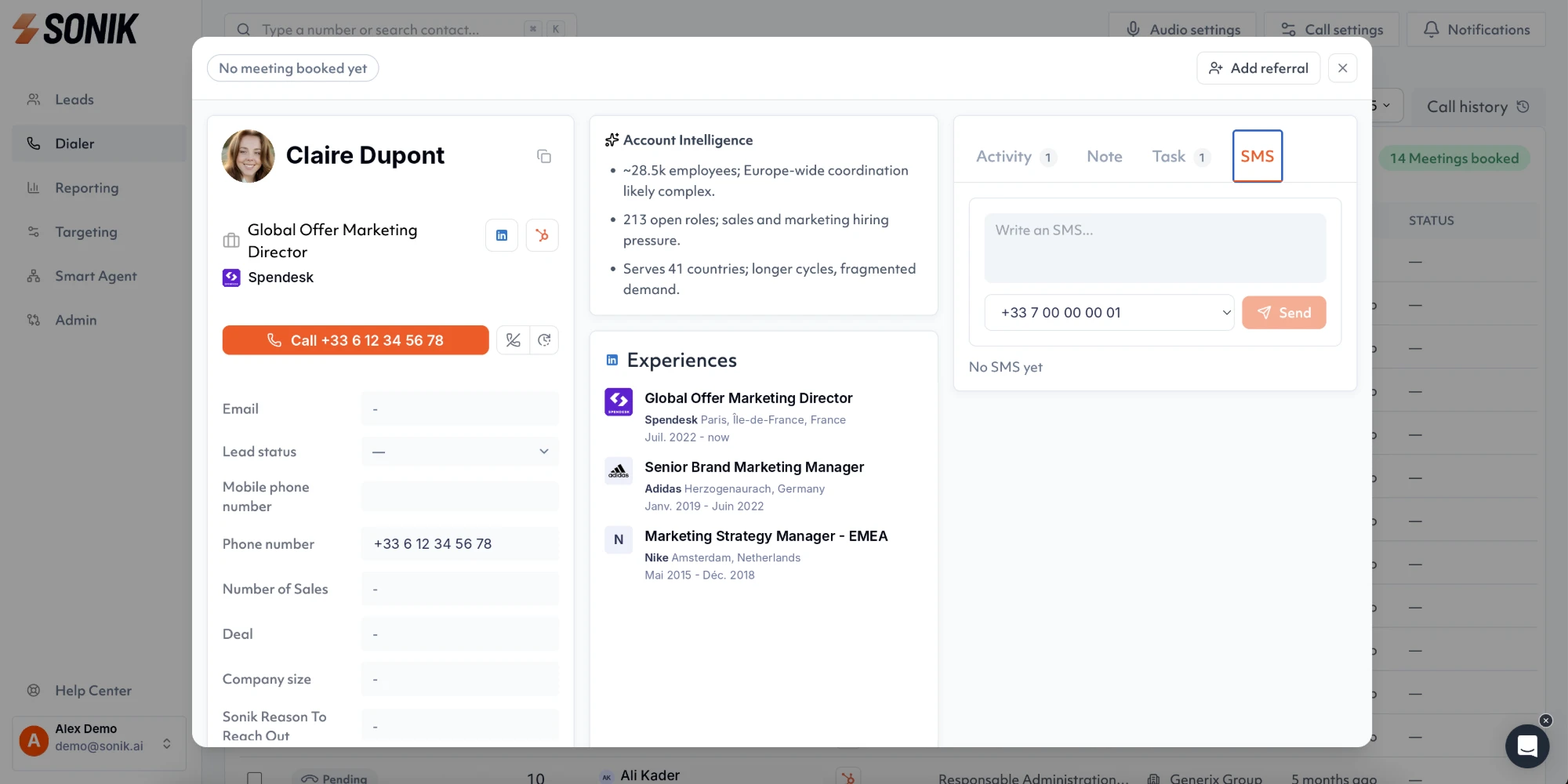
Parallel dialing gives reps around 5x more conversations, the live coach watches the opener and the objections, and the CRM is written for the rep. Our mission in one line: 2x more meetings through 5x more conversations with the right contacts. That is the 2026 trend list, built into one product.
Every trend on this list points to the same place: more real conversations with people who have a reason to talk to you now. This week, put conversations per day on the team dashboard and build Monday's list from the signals you already own. The rest of 2026 follows from those two moves.

