Get started
Still unsure of the impact of Sonik?
See it for yourself and ask for your free trial

High-velocity sales is a model built on many small deals, short cycles and a high number of conversations per rep. It works when you run it as a math problem: pipeline velocity is opportunities times deal value times win rate, divided by cycle length, and the daily lever you control is conversations.
The model rarely fails loudly. It fails when connect rates slide, data ages and reps tire, all while the activity dashboard looks fine.
High velocity suits products that one or two people can buy without a committee, that a rep can explain in a call, and that sit in a large market. Think of tools sold to small and mid-sized teams at a modest annual price.
It fits badly when a deal involves a buying group and a long evaluation. There, more dials do not shorten the cycle. Multithreading does, and we cover it in our piece on calling the whole buying committee. If you are unsure which side you are on, volume versus value helps you decide.
Write it down once: velocity = (opportunities x average deal value x win rate) / sales cycle length. Revenue per day, in other words.
In a high-velocity motion, deal value and win rate move slowly. Cycle length is mostly set by your product. The input a team can change this quarter is the number of opportunities, and opportunities come from conversations with the right people.
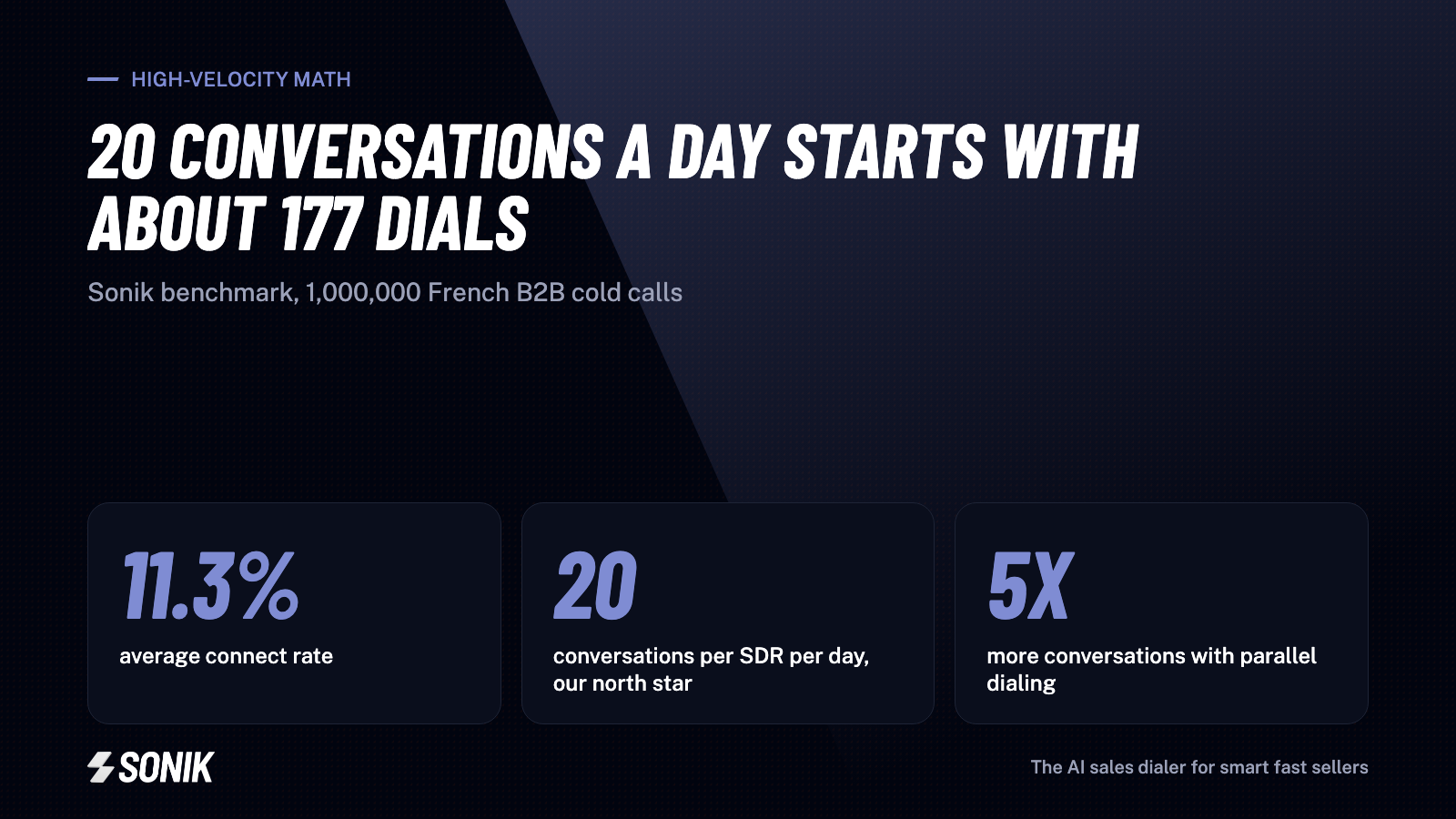
Our north-star funnel is 20 conversations per SDR per day. Work backwards to see what it takes.
Those numbers come from the Sonik benchmark of 1,000,000 French B2B cold calls. Your own numbers will differ by persona and by list. The point is to know yours. A rep who needs 177 dials a day to reach 20 conversations is spending most of the day on dial tone.
When the cycle is days, not months, the time between a conversation and the next step is the whole game. Three habits keep the loop short.
High-velocity teams usually split the work: SDRs create conversations and book meetings, AEs run short evaluations and close. Each role does fewer things, so each loop is quicker.
Two rules keep the split healthy. First, write down the handover standard: what the AE must know before a meeting starts, and how fast the AE must follow up. Our 9-point handoff checklist is a starting point. Second, share one playbook built from your best calls, not from a template. High velocity amplifies whatever the team does, good or bad.
At a high call volume, you burn through contacts fast. Wrong numbers, changed jobs and closed companies all lower your connect rate without any visible error. In our experience, teams notice only when the weekly number is already down.
Track decay on your own base. Take a sample of records, re-check them, and count how many changed. That gives you a refresh interval based on evidence rather than on a vendor statistic.
Write the refresh interval into the plan and put it in someone's calendar, otherwise it will not happen.
Do the same for rep fatigue. A rep whose conversations per day fall for three weeks in a row, with no change in list quality, is telling you something. Talk to them before the number turns into a resignation.
Our mission is 2x more meetings through 5x more conversations with the right contacts. The first half is volume, which parallel dialing provides. The second half is relevance, which comes from signals already in the CRM and from AI call prep, so a fast rep is not a blind one.
We also treat volume as a resource to protect. Throttling, attempt caps and list refresh are part of the setup, not an afterthought.
High velocity is a math model before it is a culture. Know your dials per conversation, protect the quality of the list, and watch the conversion rates that sit behind the activity.
This week, take the last two weeks of calls, divide dials by conversations, and compare the result with 177. The gap tells you where your day is going.

