Get started
Still unsure of the impact of Sonik?
See it for yourself and ask for your free trial


The order of a cold calling list decides more than the script. Most dialers load contacts in the order they were exported, alphabetical or by creation date, which means a rep spends the best slot of the day on whoever starts with A. The right order is by probability of a conversation that matters: callbacks first, live signals second, persona matched to the slot third, then verified mobiles, then everything else. Here is the five-tier order we use, the numbers behind it from our benchmark of 1,000,000 B2B cold calls, and the dialer rules that keep it from decaying.
A CRM export is a table. A dialer loads the table top to bottom. Nobody decided that the first 50 contacts of the 4pm block should be the ones created in 2023 whose company name starts with "A", but that is what happens. In our data 4pm has the best connect rate of the day at 15.8%; spending it on the wrong tier is the most expensive thing a rep does all week.
Scoring models in CRMs try to fix this and mostly add a number nobody trusts. The order below needs no model. It needs five questions a dialer can answer at load time.
Anyone who said "call me Thursday at 4". They expect you, they already had a conversation with you, and a known contact called with "How have you been?" reaches around 10% success in our benchmark against 1.5% for a standard cold open. They go first, on a single line so they never hear a hold tone, and they go to the rep who made the promise.
A visit to your pricing page from a target account, a champion who changed jobs, a link opened from a previous text, a closed-lost deal whose renewal window just opened, a hiring wave. These are the triggers that make an opener work: trigger-based openers reach a 7 to 10% meeting rate in our data against 2 to 3% for pitch-first. Reps use only about 20% of the signals already in their CRM, and half of Sonik's own pipeline comes from signals that were already there. Tier 2 is where that pipeline lives.
Order within the tier by freshness. A visit yesterday beats a job change last month.
Connect rate varies by persona and by hour. Founders pick up more around 10am, marketing around 4pm, HR around 1pm; sales and leadership personas sit above 15% overall. So the 10am block should put founders and sales leaders ahead of HR, and the 4pm block should put marketing ahead of founders. No signal needed, just the persona field and the clock. This is the tier most teams never build and the easiest to add.
The cold core of the list: right company, right role, a mobile verified in the last 90 days, nothing else. These are good dials at 12 to 16% connect rate in a good slot. They fill the rest of the block after tiers 1 to 3 are exhausted. Order within the tier by account priority (ICP fit, size) if you have one, otherwise by last attempt date, oldest first.
Desk phones, numbers not verified this year, contacts with no persona. Low pickup, high voicemail. They belong at the end of the block, on more parallel lines, where the dialer absorbs the ringing and the rep only hears the few who answer. If the block ends before the dialer reaches them, nothing of value was lost. If a tier-5 contact answers and turns out to be a fit, they move up a tier for next time.
Two numbers per tier, per week: connect rate and meeting rate. Tier 1 should connect well above the list average and book at several times the rate of tier 4. Tier 2 should book at the trigger-opener rate, 7 to 10%. If tier 2 books like tier 4, the signals are not real signals, or the reps are not using them in the opener. If tier 3 does not beat tier 4 on connect rate, the persona-slot mapping is wrong for your market; measure your own and replace ours.
Teams that read about prioritisation build a 12-factor score with weights nobody can explain, and reps stop trusting the list within a month. Five tiers, each defined by one question, are enough. The point is that the 4pm block starts with the people most likely to book, not that the score is clever.
Sonik builds the session list from the CRM at load time in exactly this order: dated callbacks, then the contacts with a live signal (website visits from target accounts, job changes, opened links, closed-lost past trigger), then personas matched to the slot, then verified mobiles, then the rest on parallel lines. Attempts and dispositions re-sort the list for the next block automatically.
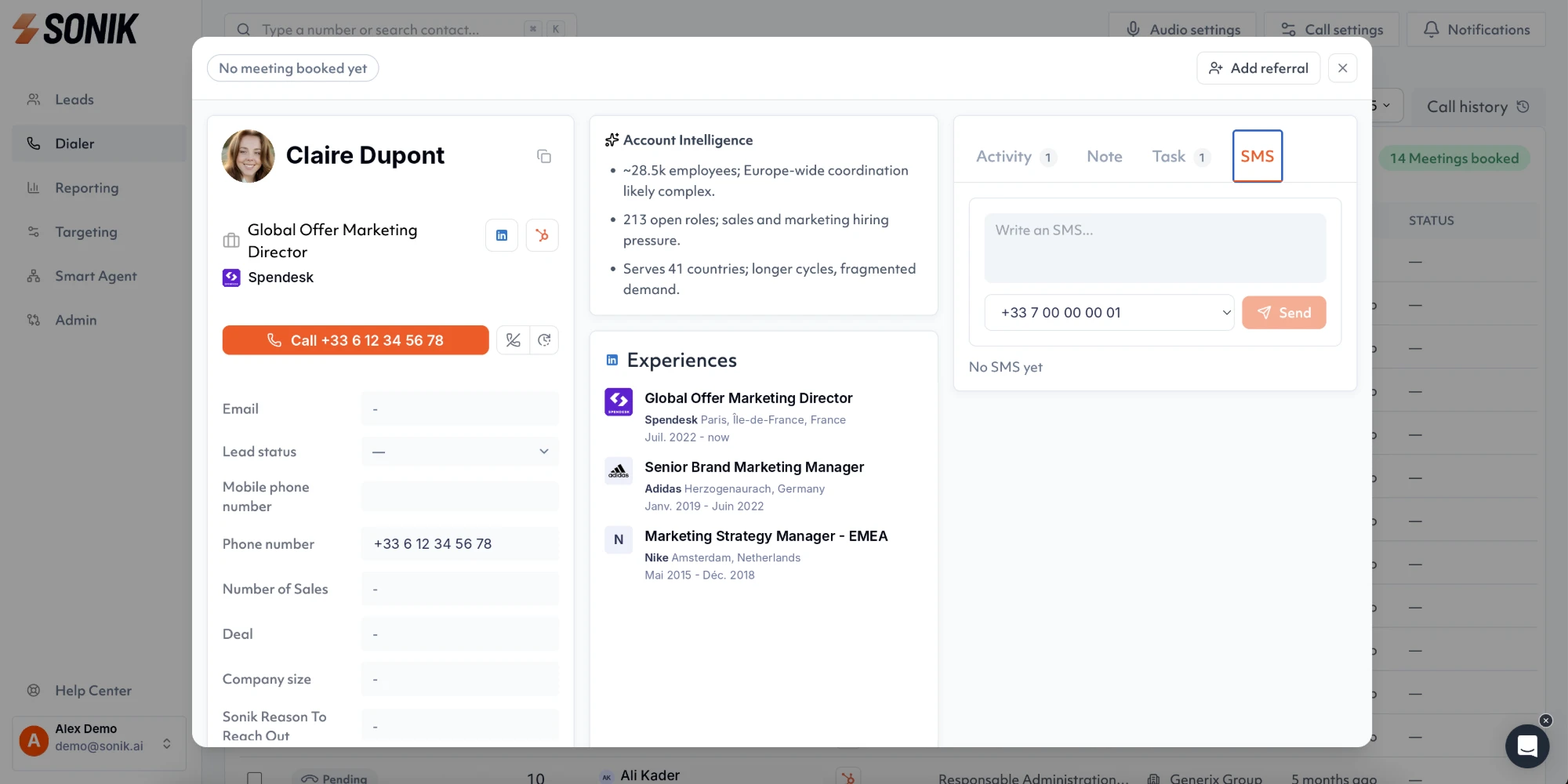
Before each call the rep sees why the contact is at the top: the signal, the account intelligence, the history and an AI qualification of the fit, so the trigger goes into the opener instead of staying in a field. The weekly report shows connect and meeting rate per tier, which is the check above, built in.
The order of the list is a decision, and most teams let the export make it. This week, before the 4pm block, sort tomorrow's list by the five tiers by hand, callbacks and signals first, and compare the meeting count with last week's same block. Then make the dialer do the sorting, every load, so the best slot always goes to the best contacts.

