
7 B2B Sales Methodologies Compared: Which One, When
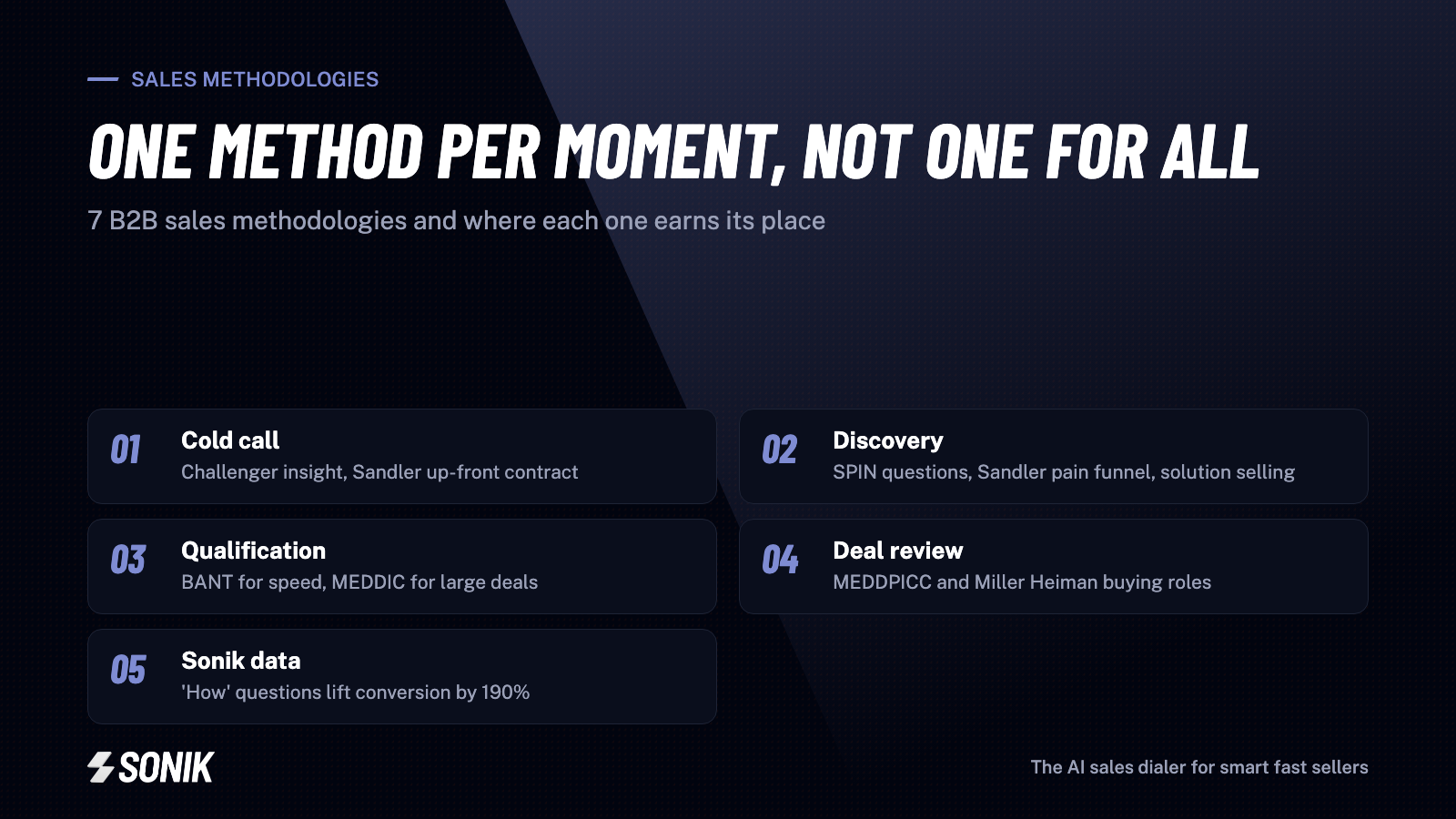
There is no best B2B sales methodology. Each one was built for a moment of the cycle: SPIN and Sandler for discovery, Challenger for the opening message, BANT for a fast first filter, MEDDIC and Miller Heiman for qualifying and reviewing large deals, solution selling for tying a problem to an outcome. The teams that perform pick one method per moment and train it properly.
Here is what each of the seven is for, when it helps, and what an SDR can keep from it on a three-minute call.
What a sales methodology is actually for
A methodology is a shared language. It tells a rep what to ask, a manager what to inspect, and an AE what a qualified deal looks like.
It is not a script and it is not a CRM process. Teams get into trouble when they adopt a method as a form to fill in. The fields get completed and nobody listens to the buyer any more.
It also helps to separate two families. Conversation methods shape what you say on a call: SPIN, Challenger, Sandler, solution selling. Qualification and deal methods shape what you know about an opportunity: BANT, MEDDIC, Miller Heiman. You need one of each, not seven.
The 7 B2B sales methodologies in one paragraph each
SPIN Selling
Neil Rackham's method orders discovery in four question types: Situation, Problem, Implication, Need-payoff. Its strength is making the buyer say the cost of the problem out loud. Best in discovery calls on considered purchases. Our take on the phone version is in SPIN and the Sandler pain funnel for cold calls.
The Challenger Sale
From Matthew Dixon and Brent Adamson: teach the buyer something about their business, tailor it to their role, take control of the next step. It shines when buyers think they have no problem. See Challenger for SDRs.
Sandler
David Sandler's system puts the seller and the buyer on equal footing. Two tools travel well: the up-front contract, where you agree on the purpose and the possible outcomes of the call, and the pain funnel, a sequence of deeper and deeper questions. Best when reps chase deals that never close.
MEDDIC and MEDDPICC
A qualification checklist for complex deals: Metrics, Economic buyer, Decision criteria, Decision process, Identify pain, Champion, with Paper process and Competition added in the longer version. It is a deal inspection tool, not a way to talk. Details in MEDDIC and MEDDPICC for SDR to AE handoffs.
Solution selling
Also called consultative selling. You diagnose before you prescribe, and you sell the outcome rather than the feature list. Most modern methods descend from it. Its risk is the endless discovery that never reaches a proposal.
BANT
Budget, Authority, Need, Timing, a filter that came out of IBM. It is quick and easy to teach, which is why SDR teams still use it. Its weakness is that outbound prospects rarely have a budget line for a problem they have just discovered. We compare the alternatives in lead qualification frameworks.
Miller Heiman strategic selling
A method for deals with several decision makers. It names the buying roles (economic buyer, user buyers, technical buyers, coach) and plans each one. Best for account planning on large accounts. See Miller Heiman explained.
Which methodology at which moment of the cycle
Map the method to the moment and the choice becomes much easier.
- Cold call. Challenger for the reason to listen, Sandler for the up-front contract. You have seconds, so one insight and one agreement on the next step.
- Discovery. SPIN or the Sandler pain funnel, with a solution selling mindset. This is where questions do the work.
- Qualification and handoff. BANT when deals are small and fast. MEDDIC as soon as several people decide.
- Deal review and account planning. MEDDPICC to find the holes, Miller Heiman to cover the buying committee.
How to choose by deal size and cycle length
Small deals with one decision maker and a cycle of a few weeks do not need heavy machinery. BANT plus a light SPIN discovery is enough, in our experience. Adding MEDDPICC to a deal that closes in two calls only slows reps down.
Mid-market deals with two to four stakeholders are where SPIN or Sandler in discovery, plus MEDDIC for the handoff, start paying back.
Enterprise deals with a buying committee and a procurement step need all of it: Challenger to create the need, MEDDPICC to qualify, Miller Heiman to plan the account.
Sonik's founder sold for five years at Google Cloud, with a quota that grew from €1.5M to €10M. In our experience of deals at that size, the deal method ends up mattering more than the conversation method. Large deals are rarely lost on a weak question. They are lost because nobody met the economic buyer.
What an SDR keeps from each on a 3-minute call
An SDR does not run a methodology. An SDR borrows one move from each.
- From Challenger: open with an insight or a trigger, not a product description. In the Sonik benchmark of 1,000,000 B2B cold calls, 65% of reps open by explaining what they sell. Trigger-based openers reach a 7-10% meeting rate against 2-3% for pitch-first openers.
- From Sandler: the up-front contract. "Give me thirty seconds, then you tell me if it is worth continuing."
- From SPIN: one problem question and one implication question, both starting with "how". In our data, discovery questions starting with "how" lift conversion by 190%.
- From solution selling: clarify before you answer. Asking "What do you mean?" before handling an objection lifts conversion by 197% in the same benchmark.
- From BANT: need and timing only. Leave budget for the AE.
- From MEDDIC: one note on the pain and one on who else decides, written in the handoff.
- From Miller Heiman: ask who else is involved, then call them too.
How Sonik approaches sales methodologies
We do not sell a methodology. We think a method only exists if it shows up in real calls, so Sonik works on the two ends: the preparation before the call and the coaching after it.

Before the pickup, the rep sees the account context and the signals on the contact. That is what makes a Challenger-style, trigger-based opener possible at dialing speed.
After the call, AI coaching looks at what was actually said: did the rep open on a trigger, ask a "how" question, clarify the objection. And because parallel dialing gives reps 5x more conversations, they get five times more repetitions of whichever method you chose.
Conclusion
Stop looking for the one methodology. Pick a conversation method for calls and a deal method for the pipeline, matched to your deal size, and train them until they show up in recordings. This week, pull your last 10 cold calls and count how many discovery questions started with "how". If the answer is under one per call, start there.