
Lead Scoring for Outbound: A Model Your SDRs Will Trust

Lead scoring is a way to rank leads so that reps call the most promising ones first. Each lead gets points for who they are and for what they have done, and the total decides the order of the call list. Most scoring models fail for a simple reason: they were built by marketing to decide when to hand a lead to sales, and the SDRs do not believe the numbers. A model for outbound needs three components (fit, signal and reachability), few criteria, and a test against real conversations.
What lead scoring is, and the two classic families
Every model mixes two kinds of information.
- Explicit, or fit: facts about the company and the person. Industry, headcount, country, tools in use, job title, seniority.
- Implicit, or behaviour: what they did. Visited the pricing page, opened a proposal, attended a webinar, replied to an email.
A third family has appeared with machine learning: predictive scoring, where a model learns from your past won and lost deals which attributes matter. It works when you have a large, clean history. With a few hundred deals and a CRM full of gaps, a predictive score mostly learns your data-entry habits. Start with rules you can read, and move to prediction when the rules stop improving.
Why inbound-style scoring fails outbound teams
The typical model adds points for email opens, page views and form fills, and passes the lead to sales above a threshold. Three problems for a team that prospects by phone.
First, most of an outbound list has no behaviour at all. Cold accounts have not visited anything, so everyone scores zero and the order is random.
Second, the signals that do predict a good conversation are not marketing events. A new head of sales, a funding round, a champion who changed company, a deal lost twelve months ago: none of these is an email click. Reps use only about 20% of the signals already in their CRM, and half of Sonik's own pipeline comes from signals that were there all along.
Third, the model ignores whether the person can be reached. A perfect-fit lead with only a switchboard number will cost ten dials and produce nothing. Our benchmark of 1,000,000 B2B cold calls puts the average connect rate at 11.3%, with large differences by persona and time slot. A score that does not account for that sends reps to the wrong half of the list.
The three-part model for outbound
1. Fit: would we want this customer?
Three or four criteria taken from your best customers, not from a wish list. For example: B2B company, 50 to 500 employees, a sales team of at least five, based in France or the UK. And for the person: role in sales leadership or revenue operations. Score it simply: 0 to 40 points. Anything that fails a hard criterion (wrong country, consumer business) is excluded rather than scored low.
2. Signal: is there a reason to call now?
Score the events that give the rep a first sentence. A workable starting grid, to adjust with your own data:
- Asked for a callback, or picked up before: 40 points.
- Visited the pricing or demo page in the last 7 days: 30.
- Former customer or champion now in a new company: 30.
- Closed-lost deal older than 6 months: 20.
- New executive in the target function in the last 90 days: 20.
- Hiring for the roles your product serves: 15.
- Dormant lead with a past conversation: 15.
Signals decay. A pricing-page visit is worth a call today and nothing in a month. Give each signal an expiry date and let the points drop to zero after it. We described the main signals and what to say for each in 10 buying signals for outbound.
3. Reachability: can we actually talk to them?
A component most models leave out. Add points for a verified mobile number, for a direct line, for a persona that answers (sales and leadership roles pick up above 15% in our data), and for a previous pickup on that number. Subtract for switchboard-only contacts and for numbers that have failed several times. Reachability does not say the lead is better. It says the dial is more likely to become a conversation, and conversations are what a calling hour is for.
From score to call list
A score is only useful if it changes what the rep does at 10am. Three rules.
- Tiers, not decimals. Nobody acts differently on 67 versus 71. Use three tiers: call today, call this week, nurture.
- Show the reason, not just the number. "Tier A: pricing page yesterday, mobile verified" is something a rep can open a call with. "Score 82" is not.
- Order the session by tier, then by time slot. Founders pick up more around 10am, marketing around 4pm in our benchmark. The score decides who, the slot decides when. We covered session order in who to call first.
Test the model on conversations
A scoring model is a hypothesis. Check it every month with two numbers per tier: the connect rate and the meeting rate per conversation. If tier A does not beat tier C on both, the model is decoration.
The benchmark gives an order of magnitude for what a good signal is worth. Calls opened with a trigger book a meeting on 7 to 10% of conversations, against 2 to 3% for a pitch with no reason. Calls to people who already know you succeed about 10% of the time, against roughly 1.5% cold. If your top tier is not showing a gap of that kind, the signals in it are not real signals.
Then ask the reps. Each month, have every SDR name three leads the model ranked too low and three it ranked too high. Their corrections are the best source of new criteria, and being asked is why they will trust the result.
Five mistakes to avoid
- Too many criteria. Twenty attributes with two points each produce a score nobody can explain. Start with ten in total.
- Scoring opens and clicks. Automated opens and link scanners make email engagement an unreliable input for deciding who to call.
- No decay. Last year's webinar attendee still sitting in tier A.
- No negative points. Students, competitors, existing customers and people who asked not to be called should drop out. The last group is also a compliance matter: an objection to prospecting has to be honoured under GDPR.
- Set and forget. A model that was right in January is wrong by June if your market or product moved.
How Sonik approaches lead scoring
We do not show reps a number. We build the day's call list from signals and reachability, and we show why each contact is on it.
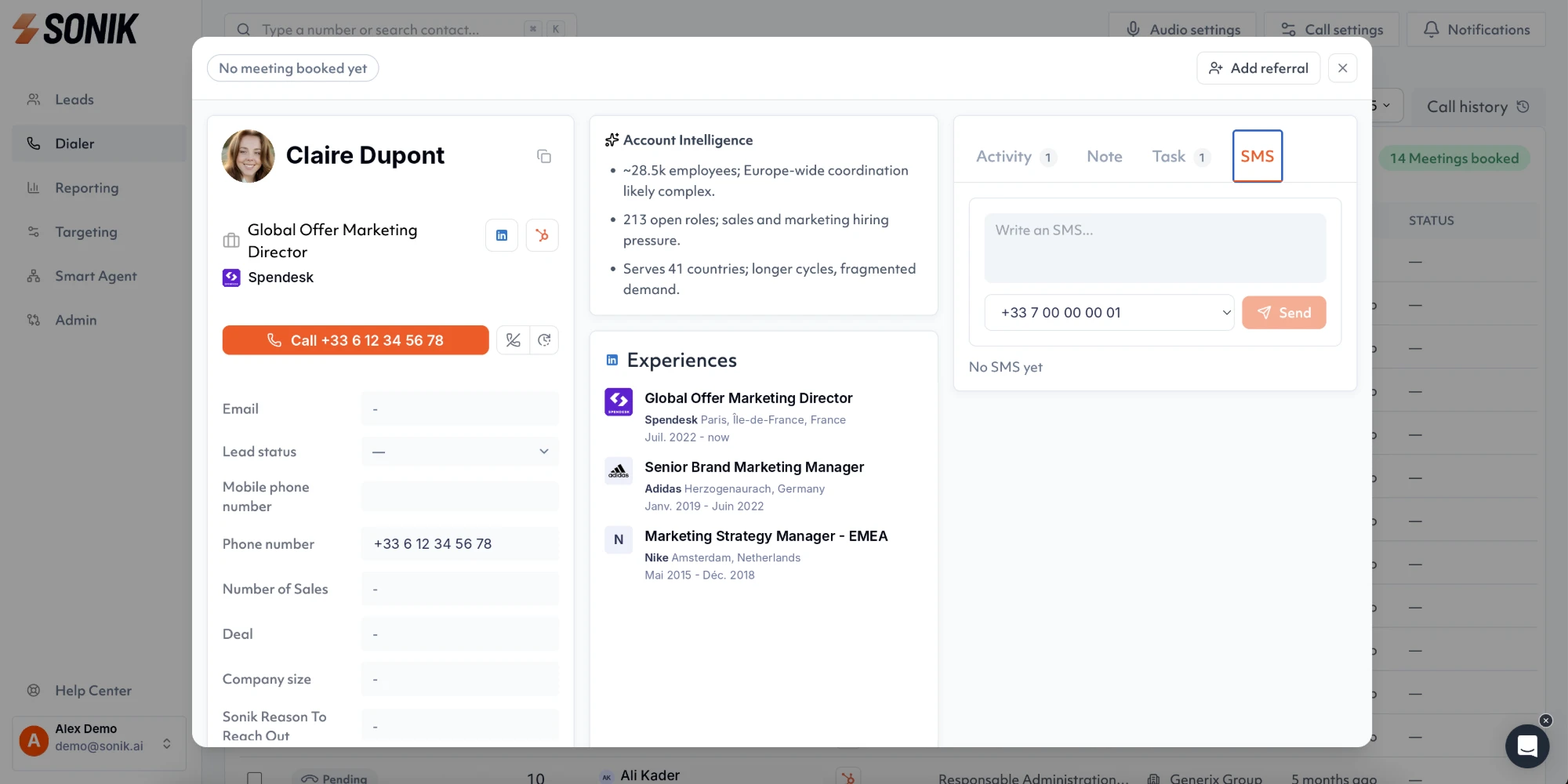
In Sonik, contacts, personas and signals come from your CRM views: website visitors, job changes, closed-lost deals, dormant leads, social intent. They become a daily calling list ordered by persona and best time slot. The contact view gives the reason for the call before the pickup, and call outcomes feed back in: a pickup or a callback request moves the contact to the top of the next session. The scoring is in the order of the list, which is the only place a rep looks.
Conclusion
A lead score for outbound answers three questions: is this the right account, is there a reason to call now, and can we reach the person. Keep it to ten criteria and three tiers, and test it on connect and meeting rates. This week, take the 50 leads your current model ranks highest and count how many have a live signal and a mobile number. That count is the real quality of your model.